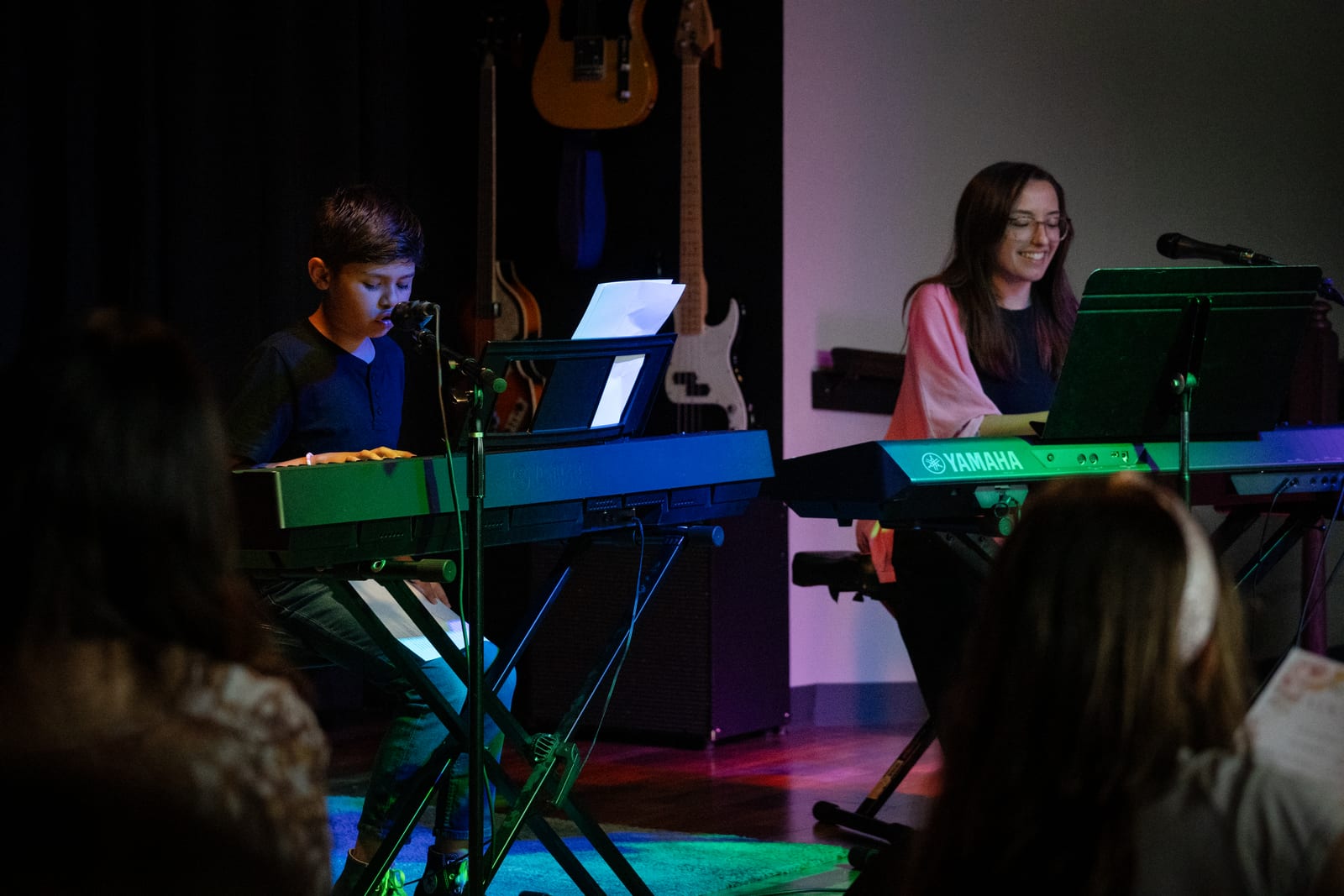
There's a moment that hits every Twelve Tone student eventually — the first time a song they've been working on actually feels like music. That moment, repeated for years, is what learning an instrument really gives a kid. Here's what's actually waiting on the other side of those first hard weeks.
How does learning an instrument boost cognitive ability?
Twelve Tone students engage memory, problem-solving, motor control, and pattern recognition simultaneously every lesson. The cognitive workout is real and well-documented — music students consistently outperform peers on memory and academic measures.
Brain plasticity is highest in childhood, so starting young at Twelve Tone Little Tones (ages 4–5) or Piano Lab (ages 6+) compounds these benefits over years.
Can playing music actually reduce stress?
Yes. Twelve Tone instructors and parents both observe it: students reach for the instrument after a hard day and visibly settle down. Music triggers dopamine and endorphin release, and the focused attention required is genuinely meditative.
An instrument becomes a stress regulator that travels with the kid for the rest of their life.
How does music build creativity?
Twelve Tone students don't just play assigned songs — instructors build improvisation, arrangement choices, and original songwriting into the curriculum at every level. Creativity is a muscle, and music is one of the best places to train it.
Kids who learn to make music tend to be more creative across the board — visual art, writing, problem-solving, even social situations.
How does playing an instrument build confidence?
Twelve Tone students face down hard pieces, perform in front of audiences, and earn measurable progress every term. That cycle — challenge, struggle, breakthrough — is the most reliable confidence-builder in any childhood activity.
Confidence built through earned competence beats any pep talk a parent can deliver.
What are practical tips for staying with it?
Twelve Tone instructors recommend four habits: practice consistently (15–30 minutes a day, four to five days a week), don't rush the basics, work with an experienced teacher who knows how to teach kids specifically, and remember that music is supposed to be fun.
Most kids who quit music quit because the curriculum stopped being fun. Twelve Tone's Lab format and song-based curriculum exist specifically to keep that from happening.
- Practice 15–30 minutes a day, four to five days a week
- Don't skip the boring fundamentals — they're load-bearing
- Work with a teacher who actually teaches kids (not adults scaled down)
- If practice stops being fun, change the song before changing the kid