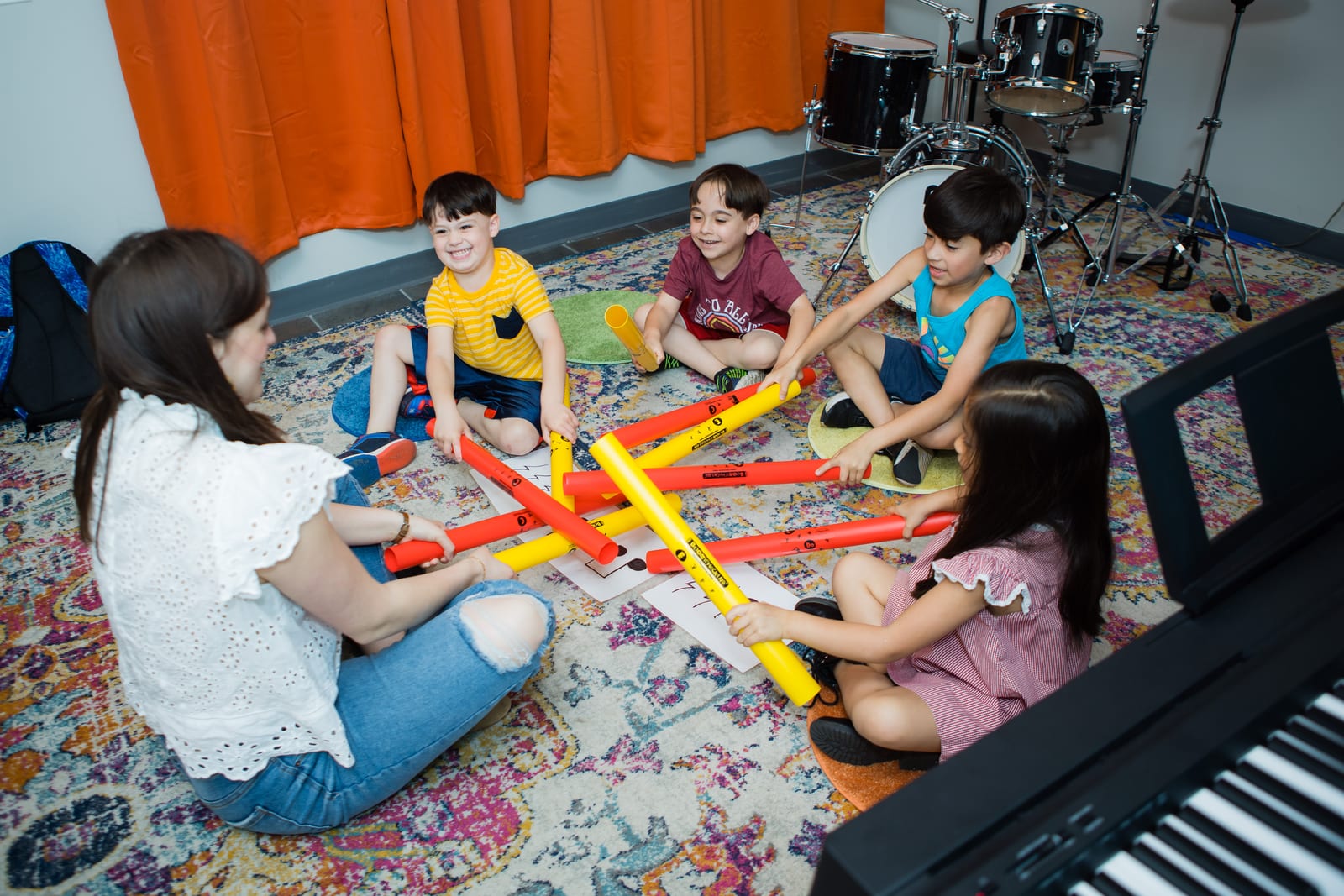
Of all the reasons parents enroll kids at Twelve Tone Music School in Glenview, the cognitive payoff might be the most underestimated. Learning an instrument literally restructures the developing brain — improving memory, concentration, language processing, and emotional regulation in ways that show up in school and life.
How does music affect a developing brain?
Music engages multiple brain systems at once — auditory processing, motor control, visual cortex (when reading sheet music), language centers, and the limbic system that handles emotion. Twelve Tone instructors take students through all of these in every lesson, and the cumulative cognitive workout is what the research is measuring.
Playing music also triggers dopamine release, which is part of why kids leave a lesson feeling good. Repeated dopamine paired with focused effort builds positive associations with hard work that generalize beyond music.
Does playing an instrument actually improve memory in kids?
Yes — and the effect compounds. Twelve Tone students hold pieces in working memory while reading ahead, recalling fingerings, and listening to bandmates simultaneously. That's a memory workout repeated daily.
Studies consistently show music students outperform peers on both verbal and working memory tests, with effects strongest in students who started young and practiced consistently.
How does music training improve concentration?
Twelve Tone Lab and private students develop the kind of sustained, focused attention that's increasingly rare in a notification-saturated childhood. A 45-minute lesson is 45 minutes of one-thing-at-a-time — and that focus muscle, once built, transfers.
Parents often notice better focus on homework within a few months of consistent practice. It's not coincidence; it's transfer.
Why is starting young especially valuable?
The brain's auditory and motor systems are particularly plastic in childhood — especially before age 10. Twelve Tone Little Tones (ages 4–5) and Piano Lab (ages 6+) catch students in this window when neural connections form fastest.
Older students still benefit enormously, but young learners gain a head start that's hard to replicate later.
How does group music help cognition specifically?
Twelve Tone Labs add ensemble cognition to solo cognition: students must hold their own part while listening to and adjusting for three peers. That divided-attention skill — focusing on yourself while monitoring others — is one of the hardest cognitive skills to teach, and music teaches it accidentally.
It's also one of the most useful skills in adult life — meetings, sports, driving, classroom discussion. Kids who play in groups practice it weekly.